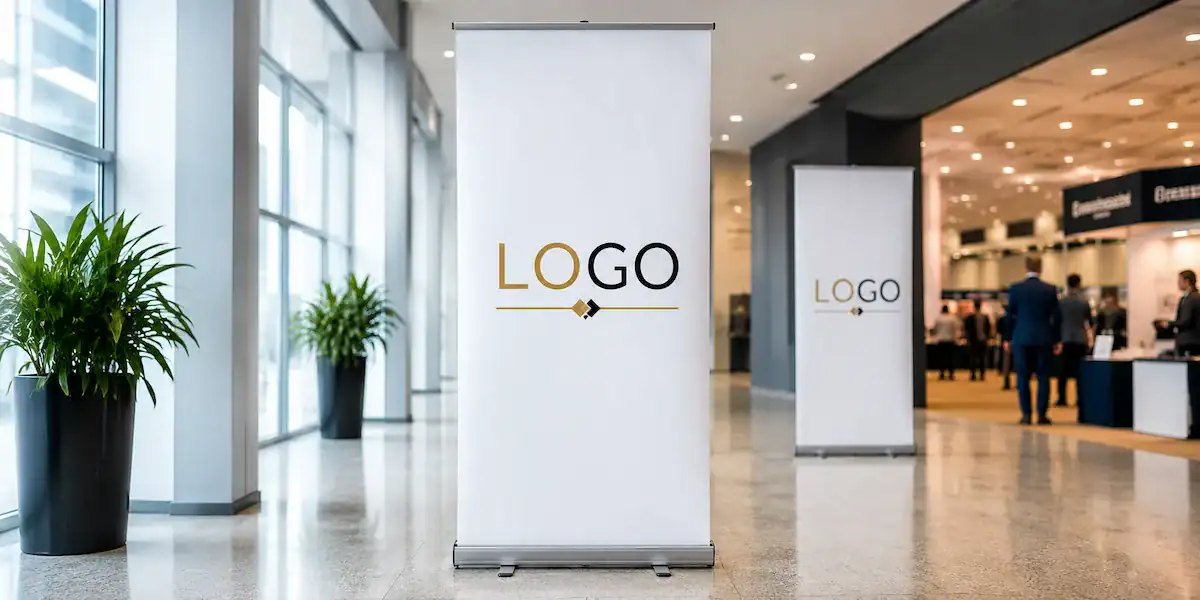
A retractable banner stand is a self-contained sign: a weighted base, a vertical pole, and a fabric or vinyl graphic that pulls up out of the base and locks into place. No tools, no assembly beyond extending the pole, and it breaks back down to a single carry case in under a minute. That’s the whole appeal — fast setup, minimal footprint, and enough visual presence to work as standalone signage or alongside a larger display.
Here’s what to know before you order one.
Most retractable banner stands run in the 33″ to 36″ width range and roughly 80″ tall once fully extended — tall enough to be seen across a room, narrow enough to fit through a standard doorway without disassembly. Wider format stands exist for booths that need more visual weight, but the standard width covers the large majority of use cases: entrance signage, directional markers, and single-message displays. See current sizing on the Retractable Banner Stands page.
A standard retractable stand ships as a base, pole, and graphic that assemble in a few steps. A one-piece retractable banner integrates those components into a single unit that requires even less setup — useful if you’re prioritizing speed over the ability to swap graphics independently of the hardware. See the one-piece retractable pullup banners page for that option.
Retractable banners do a job that backwalls and step-and-repeats can’t: they’re light enough to reposition mid-event and work well as standalone entrance or directional signage. Pairing one with a fabric backwall is common at trade show booths — the backwall anchors the space, the banner stand directs traffic toward it. We covered backwall options in HopUp vs Formulate, and banner stands as part of a full pre-show checklist in Fall Trade Show Booth Prep.
Setup is genuinely fast: extend the pole, pull the graphic up to the top hook, done. Breakdown reverses the same steps and the whole stand collapses into a carry case narrow enough to check as standard luggage on a flight, which matters if you’re traveling to a show rather than driving. This is the main practical advantage over a backwall display, which typically needs more setup time and a larger case.
Vinyl graphics are the traditional standard — durable, cost-effective, and fine for most short-term or single-event use. Fabric graphics cost more but resist creasing better over repeated roll-up cycles, which matters if the same banner is getting used across many events rather than printed once and retired. If you’re ordering one banner for a single event, vinyl is usually the practical choice; if it’s going into regular rotation, fabric holds up better long-term.
What size is a standard retractable banner stand?
Most run 33″ to 36″ wide and roughly 80″ tall once fully extended, which covers most entrance and directional signage use cases.
What’s the difference between a one-piece and standard retractable banner?
A standard retractable stand has separate base, pole, and graphic components. A one-piece version integrates these into a single unit for faster setup, at the cost of being able to swap the graphic independently of the hardware.
Should I get a retractable banner stand or a backwall display?
They serve different purposes. A backwall anchors a space as the main branded surface, while a retractable banner is lighter, faster to set up, and better suited to entrance or directional signage. Many booths use both together.
How long does it take to set up a retractable banner stand?
Typically under a minute — extend the pole and pull the graphic up to the top hook. Breakdown takes about the same amount of time.
Should I choose fabric or vinyl for the banner graphic?
Vinyl is durable and cost-effective for single-event or short-term use. Fabric costs more but resists creasing better over repeated roll-up cycles, making it the better choice if the same banner will be reused across many events.
Ready to order a retractable banner stand? Browse sizing and options or see the one-piece retractable style.


