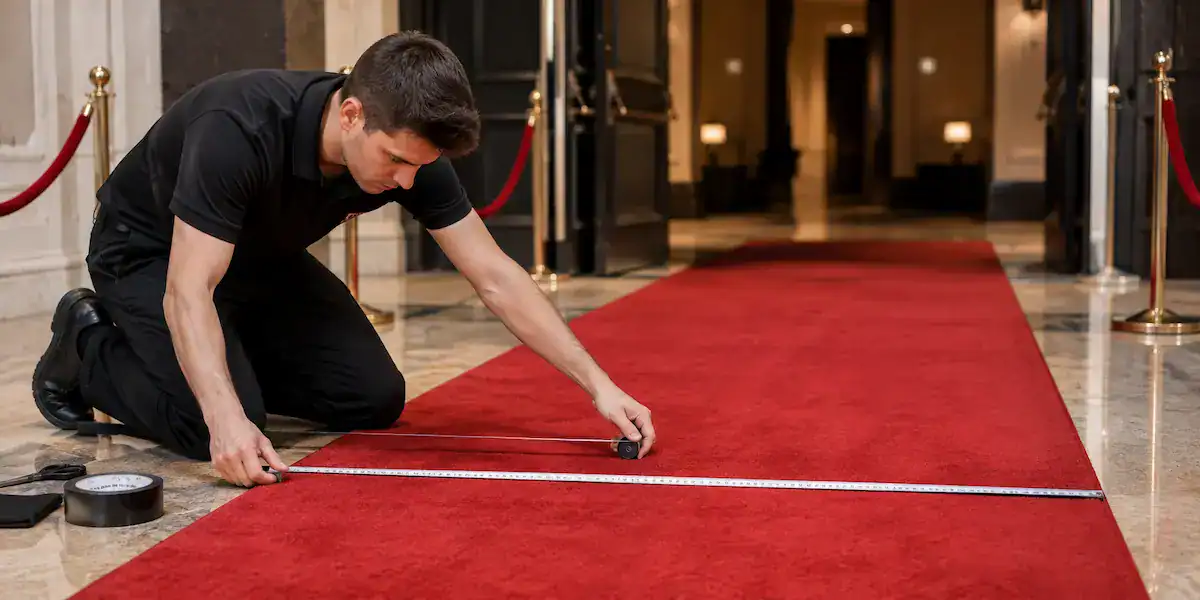
To measure for a custom carpet runner, you need three numbers: the width of your entrance or walkway, the total length from start to finish, and a couple extra inches on each dimension for a clean fit. Get those right and everything else — color, material, edging — is just preference.
Here’s how to take each measurement so your runner fits the space instead of fighting it.
Stand at the narrowest point of your entrance, doorway, or walkway and measure wall to wall (or railing to railing, if you’re working an outdoor path). This narrowest point is your ceiling — a runner wider than it won’t lay flat.
Standard runner widths are typically 3′, 4′, and 6′, which cover most doorways, hallways, and single-file entrance lines. For wider red carpet entrances meant for group photos or multiple guests walking side by side, 8′ to 12′ is more typical. Browse current width and color options on the Red Event Carpet Runners page, or see the full range of colors on the event carpet color runners collection.
Measure from your true starting point — the curb, the parking area, the base of the stairs — to where the runner should end, such as a stage, entrance door, or step-and-repeat backdrop. Walk the actual path rather than estimating in a straight line if your entrance has any turns or elevation changes; runners are cut to a single straight length; and you don’t want a redo halfway through.
If your entrance connects to a photo backdrop, plan the runner length to end a foot or two before the backdrop rather than butting right up against it — it gives guests a natural stopping point before they turn to pose.
Measure the space, then round up. A runner cut to the exact inch of your measured space can end up a hair short once it’s laid down and settled, especially on carpet-over-carpet installs where padding compresses the edges slightly. A couple of extra inches in length and width gives you room to trim on-site if needed, rather than discovering you’re short with no way to fix it before doors open.
Not every entrance is a straight rectangle. Circular photo spots, round stages, or curved lobby areas need a different approach than a standard runner. For those, a custom circle carpet is worth considering instead of trying to force a rectangular runner into a round space.
We’ve also written about how carpet runners direct foot traffic at events, which is worth a read if you’re still deciding on width and placement rather than just length.
Measuring gets the size right; securing it gets the safety right. A runner that shifts underfoot is a hazard regardless of how well it was measured. See Carpet Tape for Events for how to secure a runner once it’s laid down, particularly on hard flooring where it has nothing to grip.
What width carpet runner do I need for my entrance?
Measure the narrowest point of your entrance or walkway. Standard widths of 3′, 4′, and 6′ cover most doorways and hallways, while wider entrances built for group photos typically use 8′ to 12′.
How much extra length should I add when ordering a carpet runner?
A couple of extra inches beyond your measured length gives you room to trim on-site and accounts for slight settling once the runner is laid down, rather than risking it coming up short.
Can I get a carpet runner for a curved or round space?
A standard runner is cut as a straight rectangle, so curved or round spaces are usually better suited to a custom circle carpet instead of trying to fit a rectangular runner into the shape.
How do I keep a carpet runner from sliding once it’s placed?
Carpet tape secures the runner to the floor underneath, which matters most on hard flooring where the runner has nothing to naturally grip.
Ready to order your custom carpet runner? See sizing and color options or browse the full runner collection to get started.